Widespread tissue distribution of transcriptionally active, clonally expanded HIV-1 proviruses despite suppressive antiretroviral therapy
Hiromi Imamichi, Ven Natarajan, Francesca Scrimieri, Mindy Smith, Yunden Badralmaa, Marjorie Bosche, Jack Hensien, Thomas Buerkert, Weizhong Chang, Brad Sherman, Kanal Singh, and H. Clifford Lane1
Journal of Clinical Investigation – Published April 29, 2025
For people living with HIV, today’s medicines are remarkably effective. Antiretroviral therapy (ART) can lower the amount of virus in the blood to undetectable levels, restoring immune health and preventing transmission. But ART is not a cure. When tre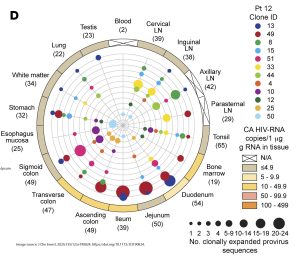 atment stops, the virus returns quickly, and a new study helps explain why.
Hiromi Imamichi and colleagues, with support from NDRI-sourced tissue donations, studied samples from people with HIV who gave their bodies to advance research. They found that the virus hides in “reservoirs” throughout the body, not just in the bloodstream. These reservoirs take the form of proviruses, which are pieces of viral DNA integrated into the genetic material of immune cells.
Because HIV infects CD4 T cells, the very cells that normally multiply to fight infections, the virus can take advantage of their ability to clone themselves. The study revealed multiple populations of these infected clones spread across many different tissue types. Even more striking, some of these cells remained capable of producing new virus despite years of suppressive ART.
The findings highlight several important challenges for HIV cure research. First, ART does not clear these hidden reservoirs, no matter how effective it is in the blood. Second, clonal expansion, the natural replication of infected cells, plays a key role in keeping the virus alive. Finally, the discovery that some reservoirs remain active under ART suggests that future therapies will need to target tissues directly, not just blood, and find ways to eliminate or control infected cells.
This study deepens our understanding of HIV persistence and shows why biomedical research, and the generosity of donors, is essential to the global effort to one day cure HIV.